Drag


Contact info
Cisco Lithium Project
The Cisco Lithium Project, James Bay, Quebec
The western hemisphere’s largest hard-rock lithium deposit by scale x grade.¹
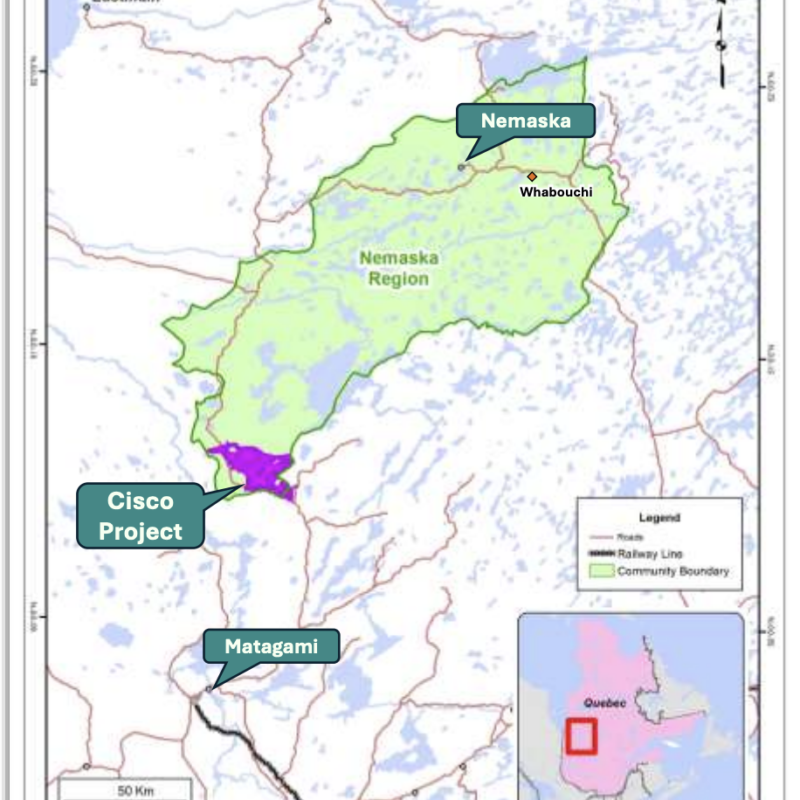
Located in the Nemaska traditional territory of the Eeyou Istchee James Bay region of Quebec, the Cisco Project is a Tier-1 critical minerals asset.
With an inaugural Inferred Mineral Resource Estimate of 295 million tonnes at 1.36% Li₂O, Cisco is positioned to supply lithium for the global clean energy transition.
Project Highlights
The Cisco Project hosts an NI 43-101 Inferred Mineral Resource of 295 million tonnes grading 1.36% Li₂O, positioning it as the largest hard-rock lithium deposit in the western hemisphere and fourth largest in the world.¹ Deposits of this scale, in stable jurisdictions with established infrastructure, are exceptionally rare as fewer than five exist globally.
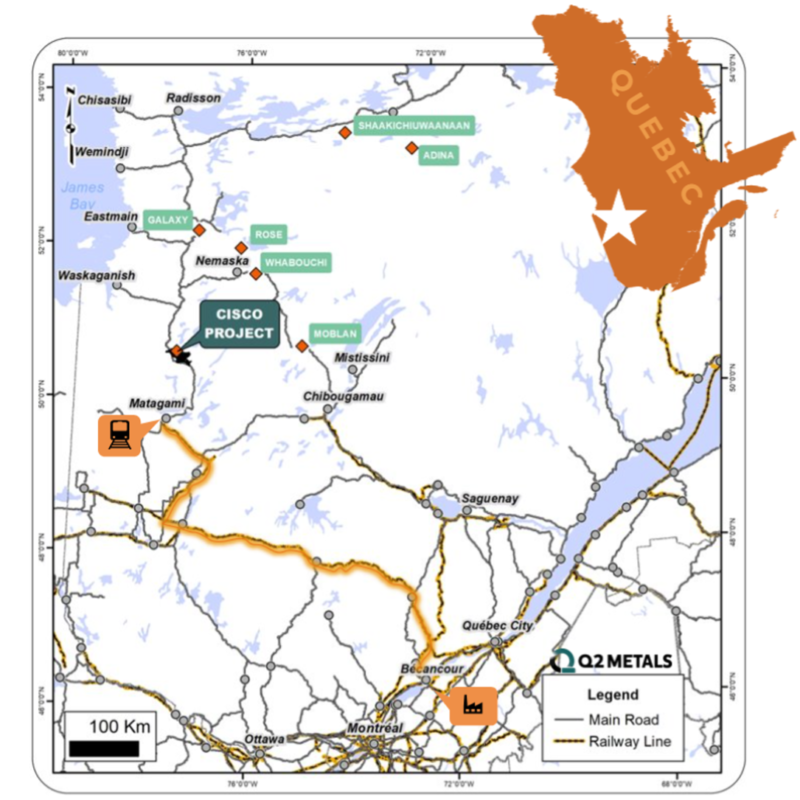
The paved, all-season Billy Diamond Highway transects the Cisco Project, connecting directly to CN Rail in Matagami, 150 kilometres to the south. That rail corridor links to Bécancour and Saguenay (Quebec’s emerging battery processing hub and international shipping ports on the St. Lawrence Seaway), providing direct access to North American and European markets.
Quebec is one of the world’s premier mining destinations, with a well-established permitting framework, dedicated critical minerals investment funds, and a stated government goal of becoming a hub for battery supply chain development. The James Bay region is an active mining corridor with a long history of resource development.
The largest field program to date at the Cisco Lithium Project has started, with the summer program targeting approximately 20,000 metres of drilling. Drilling commenced mid-June 2026 with four diamond core drill rigs that are currently at site. The focus for June through September will be on infill drilling of the Cisco Deposit to convert and advance the resource towards an Indicated classification in support of an inaugural Preliminary Economic Assessment targeted for fall 2026. A total of 9,552 m have been completed over 22 holes thus far. The deposit remains open at depth and along strike, with an Exploration Target of a further 44 to 67 million tonnes adjacent to the current resource.

MRE Results
In April 2026, Q2 Metals announced an inaugural NI 43-101 Inferred Mineral Resource Estimate for the Cisco Lithium Project, prepared by independent consultant BBA Inc. The estimate defines a combined open-pit and underground resource that positions Cisco as the largest hard-rock lithium deposit in the western hemisphere and fourth largest in the world.¹
295 Mt
Inferred Resource Based on 75 drill holes totalling 33,343 metres completed at Cisco by year-end 2025. Mineralization starts at surface and remains open in all directions.
1.36 % Li₂O
Average Grade Consistent grade across both open-pit and underground portions of the resource, with higher-grade intervals identified within the main mineralized zone.
9.9 Mt LCE
Contained Lithium Carbonate Equivalent Reflecting the scale of contained lithium within the current resource footprint, with further upside from an Exploration Target of 44 to 67 million additional tonnes adjacent to the MRE.
Scale Potential & Size of Land Package
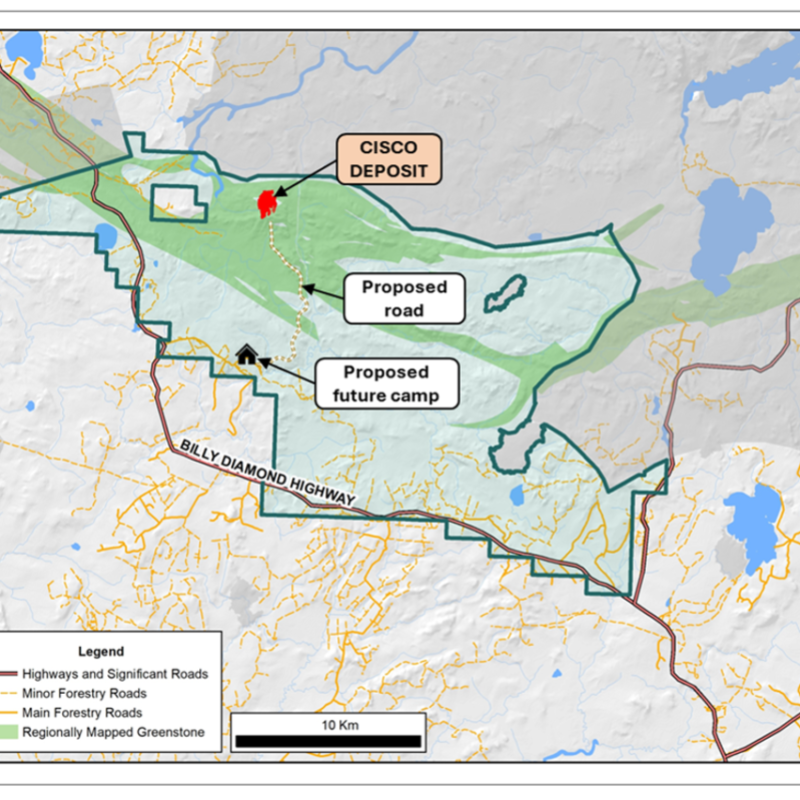
The Cisco Project is comprised of 801 contiguous mineral claims covering 41,253 hectares along the lithium-rich Frotet-Evans Greenstone Belt in Quebec’s James Bay region.
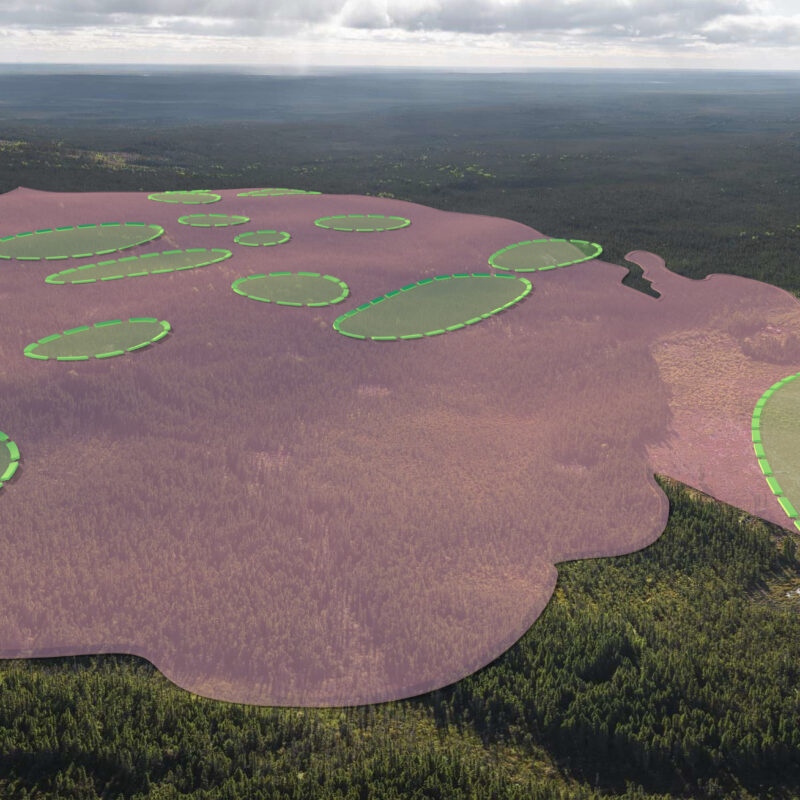
The current MRE covers only a fraction of the Project’s total footprint. An Exploration Target of a further 44 to 67 million tonnes has been defined adjacent to the current resource, and significant ground beyond that remains untested. Cisco’s scale potential is a function not just of what has been found, but of what remains to be explored.
Location & Infrastructure Advantage
The paved, all-season Billy Diamond Highway transects the Cisco Project, with the main deposit area approximately 10 kilometres to the east. Q2 Metals is currently permitting a new direct access road from the highway to the deposit, along with a new camp facility. Year-round paved road access to a lithium deposit of this scale is a significant and relatively rare logistical advantage.
The Billy Diamond Highway connects directly to the town of Matagami, 150 kilometres to the south, which serves as the regional railhead for the Canadian National Railway. The CN line connects to Bécancour, Quebec’s emerging battery processing hub approximately 215 km from the US border, and to the Port of Saguenay, providing access to international shipping via the St. Lawrence Seaway.
Quebec is positioning itself as North America’s battery supply chain hub. The Bécancour industrial park has attracted major investment from General Motors, POSCO, and EcoPro, among others. The Quebec government has committed $6 million toward transshipment infrastructure upgrades in Matagami, directly benefiting the James Bay corridor. Cisco is well-connected of this emerging supply chain geography.
Project Milestones
Since acquiring the Cisco Project in February 2024, Q2 Metals has advanced from initial drilling to a significant inaugural mineral resource in under three years.
- Q2 acquires the Cisco Project (February 2024).
- $6.5M private placement completed.
- 6,359 m drilled across 17 holes, including CS-24-018: 215.6 m at 1.69% Li₂O and CS-24-021: 347.1 m at 1.35% Li₂O.
- 24,311 m drilled across 53 holes, including CS-25-036: 272.5 m at 1.61% Li₂O, CS-25-044: 457.4 m at 1.65% Li₂O, and CS-25-073: 170.2 m at 1.99% Li₂O.
- 2025 Exploration Target announced.
- $26M institutional private placement completed.
- Keith Phillips added to Board.
- Inaugural Inferred Mineral Resource Estimate announced (April 20, 2026): 295 Mt at 1.36% Li₂O.
- Four-rig drill program ongoing.
- Advanced metallurgical testing underway.
- Permitting for new access road and camp.
- Commencement of baseline environmental studies. PEA completion targeted for late 2026.
Industry-Leading
Drill Intervals
Drilling at Cisco has consistently yielded strong lithium grades over extremely wide intervals across the main deposit area.
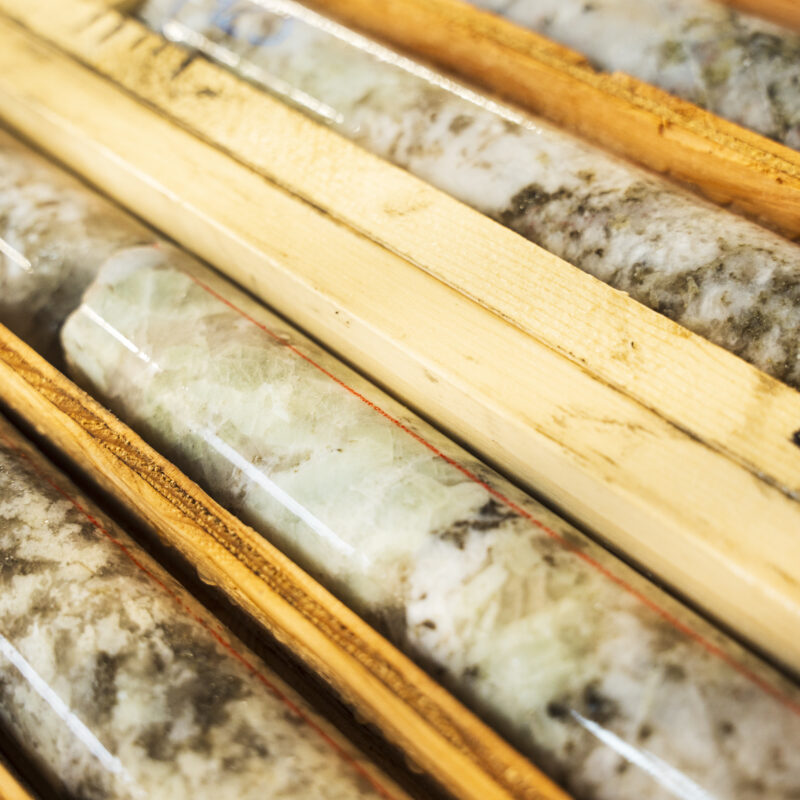
Mineralization starts at surface and extends to an average depth of 400 metres, remaining open in all directions. Drill hole CS-25-044, which intercepted 457.4 metres of continuous spodumene pegmatite grading 1.65% Li₂O, is the best lithium intercept ever drilled from a hard-rock lithium project globally, according to Canaccord Genuity².
² Canaccord Genuity Capital Markets Australian Equity Research – 3 December 2025.
Drill Hole 44
457.4 m at 1.65% Li₂O
*top global hard-rock lithium intercept*
Drill Hole 27
179.6 m at 1.66% Li₂O,
and 58 m at 1.75% Li₂O,
and 91.8 m at 1.81% Li₂O
Drill Hole 21
347.1 m at 1.35% Li₂O
Drill Hole 73
170.2 m at 1.99% Li₂O,
including 40.1 m at 2.89% Li₂O
Drill Hole 36
272.5 m at 1.61% Li₂O
Geological Setting & Metallurgy
The Cisco deposit is primarily hosted within a single, continuous spodumene pegmatite body situated along the Frotet-Evans Greenstone Belt, the same lithium-bearing geological corridor that hosts the Sirmac and Moblan deposits.
The principal pegmatite ranges in true thickness from ~2 metres to over ~450 metres, extending over a strike length of 1.8 km, with multiple associated proximate structures. Spodumene has been confirmed as the primary lithium-bearing mineral across all sampled intervals.
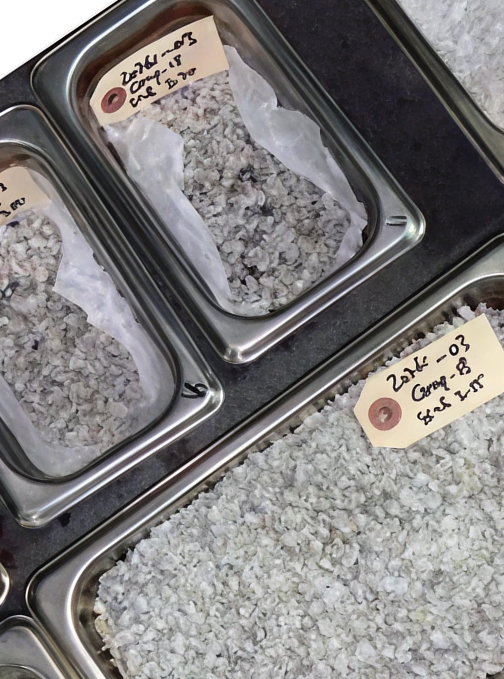
Phase one metallurgical test work using Heavy Liquid Separation (HLS) on three composite samples confirmed the potential suitability of a Dense Media Separation (DMS) process, a well-understood, conventional flowsheet widely used in hard-rock lithium production:
- Composite 18: 74.1% recovery, 5.69% Li₂O concentrate, 0.42% Fe₂O₃
- Composite 21: 69.6% recovery, 5.08% Li₂O concentrate, 0.55% Fe₂O₃
- Composite 23: 71.6% recovery, 5.60% Li₂O concentrate, 0.46% Fe₂O₃
Phase 2 metallurgy is currently underway, testing HLS on composite samples from across the full deposit area.
Current Exploration Program
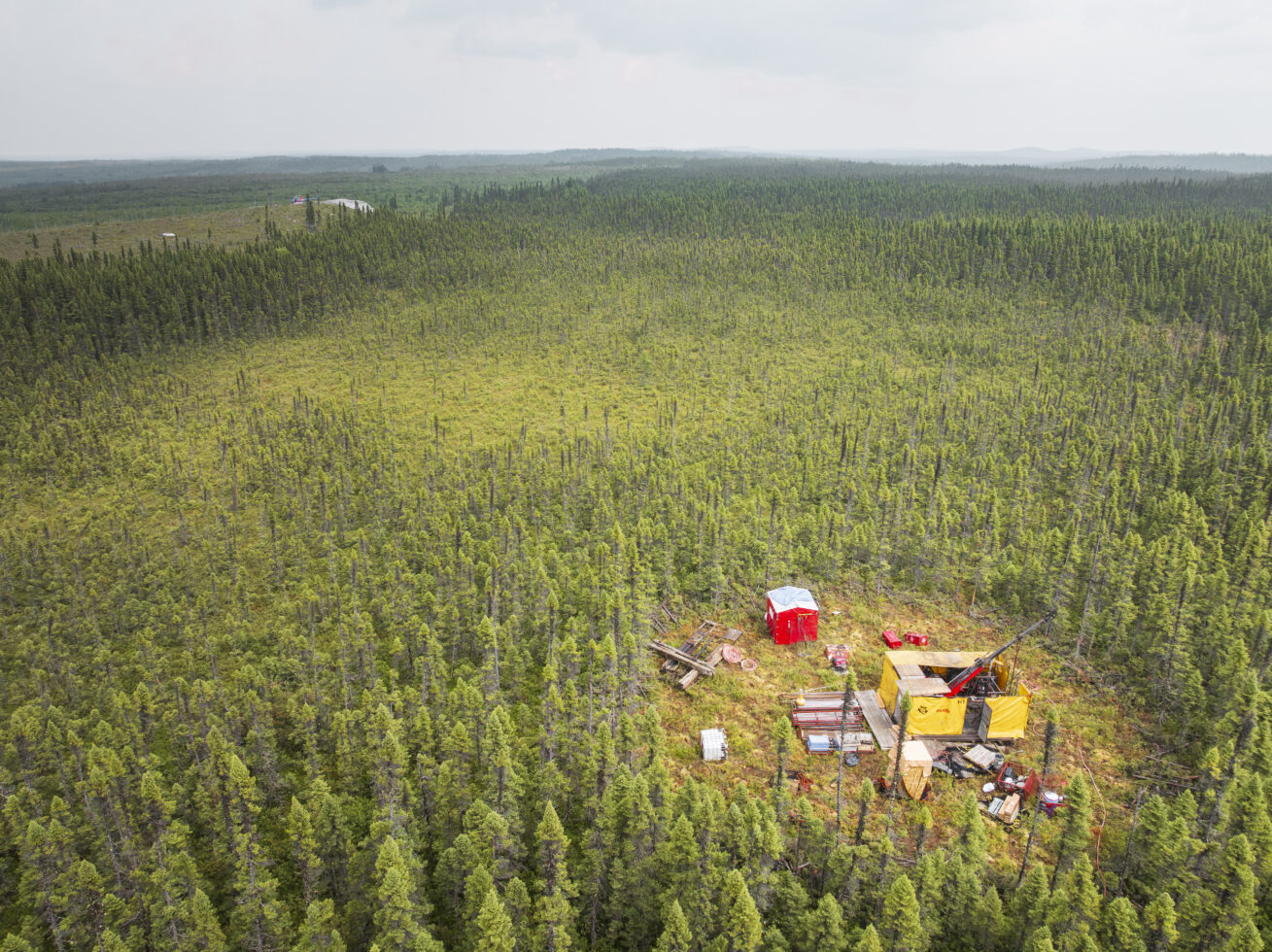
The largest drill program to date is underway at Cisco, targeting indicated resource definition to support an inaugural Preliminary Economic Assessment.
To date, Q2 Metals has completed 93 drill holes totalling 42,119 metres at the Cisco Project. The Summer 2026 program is focused on infill drilling of the Cisco Deposit to convert and advance the resource towards an Indicated classification in support of an inaugural Preliminary Economic Assessment targeted for fall 2026.
Drilling commenced mid-June 2026 with four diamond core drill rigs that are currently at site. Two additional rigs will be mobilized mid-summer to enhance the work program.
The Summer 2026 program will also test high-priority targets along strike and at depth beyond the current MRE boundary, where the deposit remains open in all directions.
Q2 is simultaneously advancing permitting for a new direct access road from the Billy Diamond Highway to the deposit area and a new camp facility to support expanded operations

Exploration Target
Significant resource growth potential beyond the current MRE footprint.
In addition to the April 2026 Inferred Mineral Resource Estimate, Q2 Metals has defined an Exploration Target for the geological environment immediately surrounding the current resource. The Exploration Target estimates a further 44 to 67 million tonnes of mineralized material grading between 0.88% and 1.35% Li₂O, representing meaningful upside to the current defined resource.
Disclaimer :
The potential quantity and grade of the Exploration Target are conceptual in nature. There has been insufficient exploration to estimate and define a Mineral Resource as defined by NI 43-101, and it is uncertain if further exploration will result in the target being delineated as a Mineral Resource.
Community Engagement & ESG
The Cisco Project is located within the greater Nemaska traditional territory of the Eeyou Istchee James Bay region, on Category 3 lands on the N20 trapline, approximately 230 km from the Community of the Nemaska Cree Nation.
Q2 Metals is prioritizing the strengthening of relationships based on early engagement, full transparency, with consistent and constructive open dialogue.
Maps & Technical Figures
Technical figures from the April 2026 NI 43-101 Inferred Mineral Resource Estimate, prepared by BBA Inc.
Project Gallery


Latest News

Q2 Metals Extends Near Surface Mineralization 100 Metres North at the Cisco Lithium Project, Intercepting 134.5 Metres at 1.20% Li2O and 101.6 Metres at 1.02% Li20
Q2 Metals Extends Near Surface Mineralization 100 Metres North at the Cisco Lithium Project, with Hole 96 Intercepting 134.5 Metres at 1.20% Li2O and...

